Syncubator Log in
IIT Mandi · Where care meets innovation

A neonatal incubator whose every decision can be read.

Syncubator is a low-cost incubator built from commodity sensors and a Raspberry Pi. It holds warmth, humidity and oxygen at the set points a clinician chooses, watches for eleven alarm conditions, and shows the same live picture on the incubator's own screen, a phone, or this website.

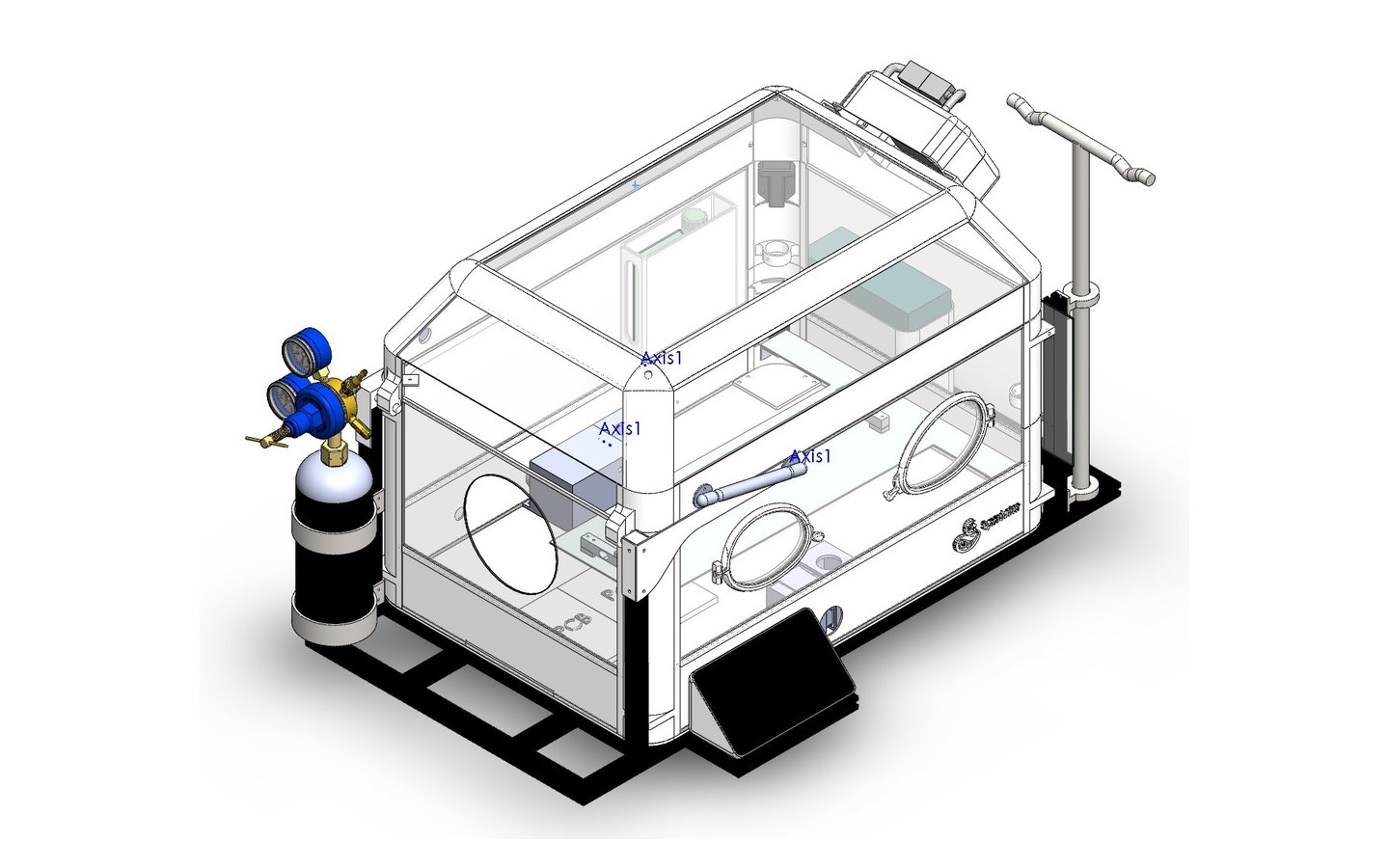
Syncubator incubator with its canopy closed: the touchscreen at the front, side access ports and the oxygen regulator
Air temp36.5°C
Humidity55% RH
Oxygen21.0%
Weight2 310g
Example values, not live data
Why build another incubator

The infants who need one most are often where one is hardest to afford.

Physiology

Preterm infants lose heat faster than they can make it.

A large surface area for their mass, little fat and an immature thermoregulatory response mean that in an ordinary room a preterm or low-birth-weight infant cools quickly, and hypothermia in the first hours of life is strongly associated with mortality.

Cost

Certified incubators do this well — at a price many district hospitals cannot meet.

A warmed, humidified, oxygen-enriched microenvironment held within limits, without continuous manual attention, is exactly what commercial incubators provide. Their cost keeps them out of the wards that need them.

Openness

Their control and alarm logic is closed. Syncubator's is not.

Every controller, threshold and alarm rule in Syncubator is software that can be inspected, adapted and repaired locally, running on hardware that can be bought anywhere.

How it works

Three subsystems, one shared view.

Climate and oxygen control, an alarm engine that keeps running whether or not anyone is watching, and a single application that reaches the incubator from wherever staff are.

Climate & oxygen

Closed-loop warmth, humidity and oxygen.

Two heaters, a humidifier and an eight-position oxygen valve are driven by a hysteresis controller: the heater switches on only once the air has fallen 1.5 °C below the set point and off only once it has risen 1.5 °C above it, so relays are not chattered at the threshold and the environment settles instead of oscillating.

  • ±1.5 °C / ±1.5 %Dead band on temperature and humidity; oxygen uses the same law in percentage points.
  • 2 sControl cycle. Disabling control forces every relay off, unconditionally.
  • PersistentSet points, limits and calibration survive power loss — written atomically to the Pi.
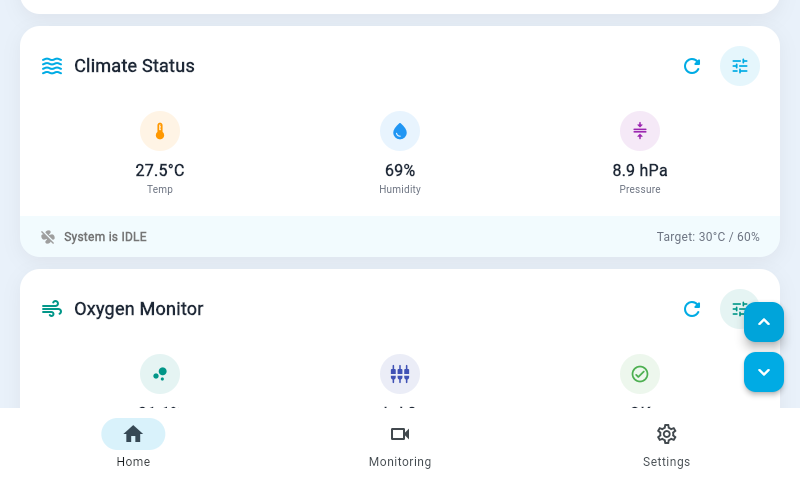
Climate and oxygen cards in the Syncubator application showing temperature, humidity, pressure and the oxygen valve level
Climate and oxygen cards as shown on the incubator's touchscreen.
Alarm system

Alarms that live on the incubator, not in the app.

The alarm engine runs as a background process on the Raspberry Pi and drives the buzzer directly. If a browser closes, a phone sleeps or the Wi-Fi drops, the alarm still sounds. Eleven conditions are checked every second and follow medical alarm conventions rather than a plain threshold test.

  • 3 prioritiesHigh, medium and low, each with its own tone and banner colour.
  • 10 s onsetA breach must persist before it alarms, so a passing reading does not wake the ward.
  • LatchingAn alarm that clears on its own stays displayed until acknowledged. Silence lasts two minutes, then re-sounds.
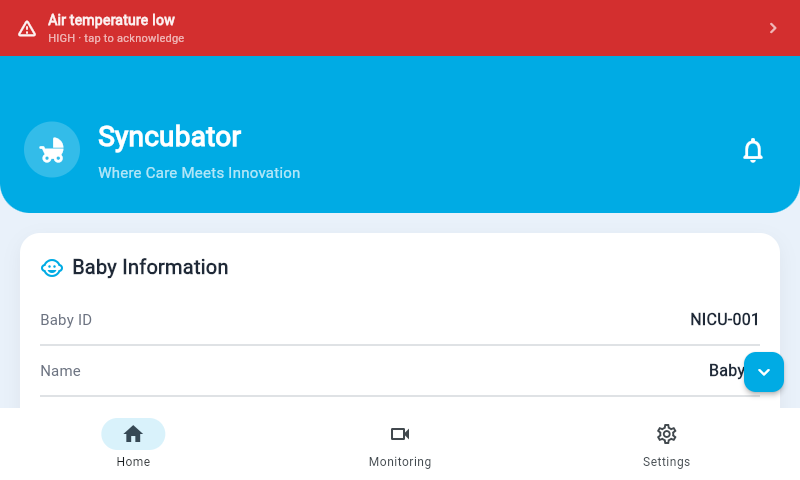
Syncubator application with a high-priority 'Air temperature low' alarm banner across the top
HIGHAir temperature lowlatched
MEDHeater on, temperature not risingrunaway check
LOWBed distance sensor not respondingsensor fault
Three of the eleven conditions, with their priorities.
Application

One application. The incubator's screen, a phone, this website.

The same code runs full-screen on the touchscreen fitted to the incubator, as an Android app, and here on the web behind a login. Every screen shows live values, the camera, and the same controls: set points, oxygen level, bed height, per-sensor restart, alarm acknowledgement and limits.

  • 1 sRefresh interval for every reading, over an encrypted connection.
  • LoginRemote access is restricted to approved e-mail addresses with a one-time code.
  • Fault-tolerantA failed sensor is reported as such, never shown as a plausible number.
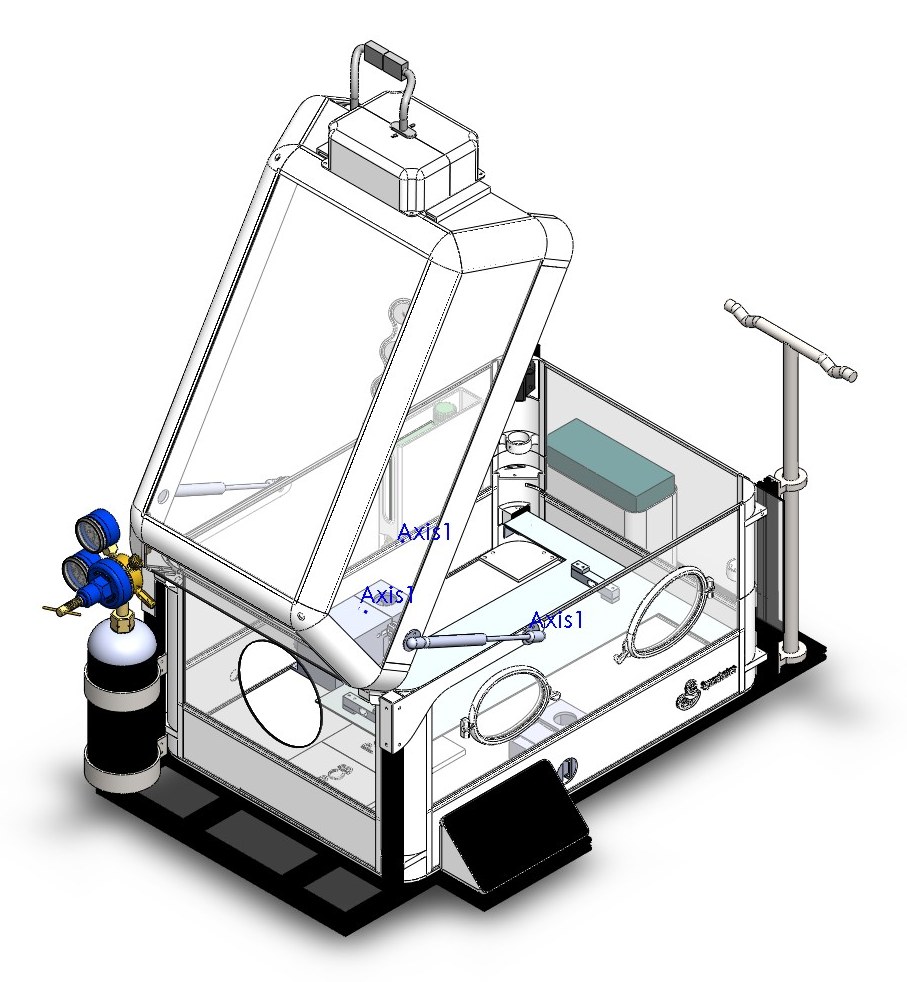
Syncubator with its canopy raised, showing the mattress platform, side ports and the oxygen supply
Mattress height 11.6cm
Sensor gate: raise from 8–15 cm
Canopy raised for access. The mattress platform is hinged at one end and tilts up on a motor, gated by a distance sensor under the free end. Try it.
Sensing & hardware

Commodity parts, calibrated.

Nothing inside is proprietary. Each sensor chain has been calibrated on the assembled unit, and the constants live in the same configuration file as the set points.

MeasuresPartsNotes
Air temperature2 × TMP117 · BME680Mean of the available sensors; a missing one is dropped, not zeroed.
HumidityBME680 · MS8607Mean of the two; hysteresis-controlled humidifier.
OxygenElectrochemical cell · ADS1115Two-point calibration (0 V → 0 %, 1.40 V → 20.9 %). Reference gas needed before clinical use.
Infant weight4 × load cell · HX711Per-cell zero and scale, corrected against a 5 kg reference mass.
Mattress heightVL53L4CD time-of-flightGates the bed motor: raise from 8–15 cm, lower from 15–25 cm, 20 s motor timeout.
CameraIMX708640 × 480 MJPEG, shared between the touchscreen and remote viewers.
ComputeRaspberry Pi 4Flask under Gunicorn, TLS terminated by nginx, all bound to the device.
Actuators2 × heater · humidifier · servo valve · bed motorRelay-driven heaters with the second as a spare; valve levels 0–7.
Data path

From a sensor to a screen.

01 · Sensors

Read every 0.2–2 s

Background threads on the Pi poll each device and write into one shared state.

02 · Controllers

Decide, then act

Climate, oxygen and alarm loops read that state and drive relays, servo and buzzer.

03 · API

One status endpoint

Flask serves the state and the control commands over TLS, on the device only.

04 · Clients

Kiosk · phone · web

Each polls once a second. Remote access passes a login wall before it reaches the incubator.

Where it stands

Operating on the assembled unit; physiological sensing next.

Working now

  • Temperature, humidity and oxygen control from operator set points
  • Alarm engine with onset delay, latching, silence and buzzer, verified on hardware
  • Calibrated weight, oxygen and mattress-height sensing
  • Touchscreen kiosk, Android app and this web dashboard from one codebase
  • Settings that survive power loss; supervised, self-restarting services

Next

  • Pulse oximetry: saturation, pulse rate and perfusion index from a neonatal wrap probe
  • Skin-temperature probes, and a servo mode that regulates the heater to skin temperature
  • Reference-gas check of the oxygen cell
  • Formal evaluation of alarm timing, control settling and weight accuracy
Team

Built at IIT Mandi.

Syncubator is developed by a student team at the Indian Institute of Technology Mandi, Kamand, Himachal Pradesh, with faculty mentorship. The alarm system, climate and oxygen control, and the application described on this page are the team's work for the current academic year; the enclosure, canopy and mattress platform form the shared platform on which they run.

Research prototype. Syncubator is an engineering project under development at IIT Mandi. It is not a certified medical device, has not been evaluated against IEC 60601 or any regulatory standard, and must not be used for the care of an infant.